“The Painter of the Wounded Land” exhibition opens in Tehran, honoring Sliman Mansour’s Palestinian
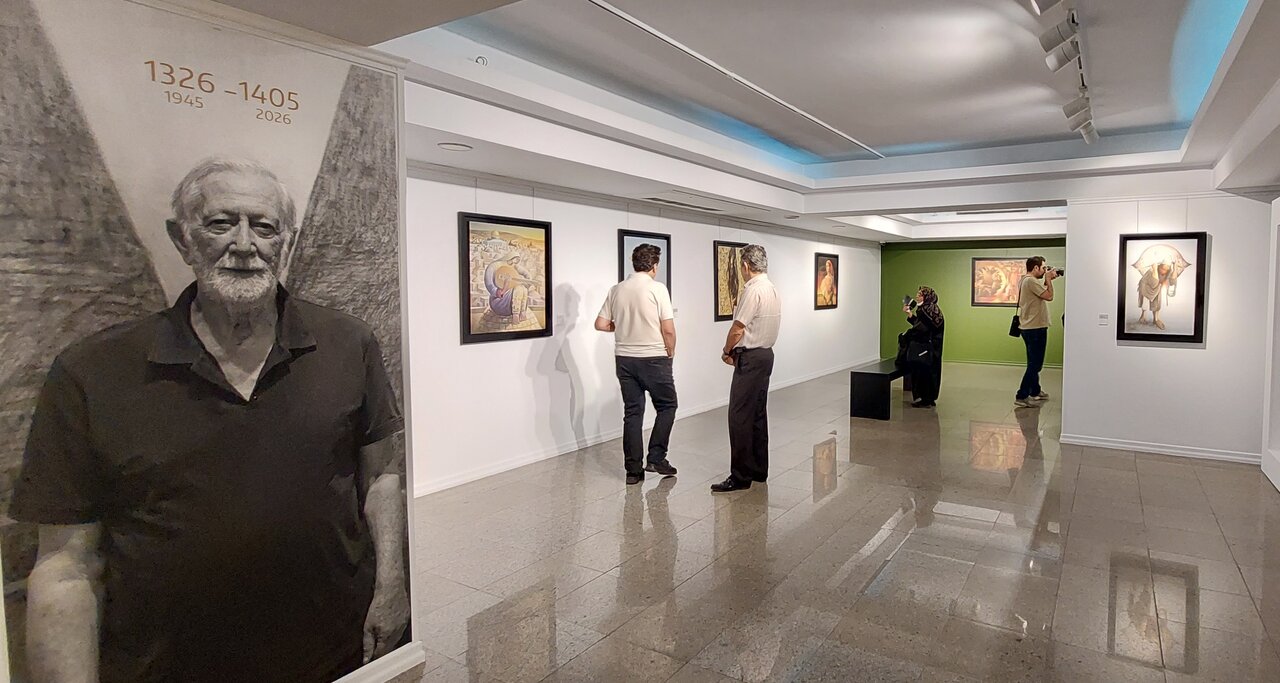
TEHRAN- The painting exhibition “The Painter of the Wounded Land,” featuring works by renowned Palestinian artist Sliman Mansour, opened at the Aali Gallery of Tehran’s Art Bureau on Sunday, showcasing an artist whose work has become closely associated with the history, identity and aspirations of the Palestinian people.
The exhibition is being held in tribute to Mansour, who passed away in August at the age of 79. It presents his artistic legacy through works that reflect his longstanding engagement with Palestinian land, culture and people.
The opening ceremony was attended by Nasser Abu Sharif, representative of the Palestinian Islamic Jihad movement in Tehran; Mohammad Zaroui Nasrabad, director of the Nam Cultural and Artistic Institute; Mohsen Momeni-Sharif, Kamyar Sadeqi, Hossein Ayni-Bakhsh, Saber Sheikh Rezai and Hossein Esmati, among others, who visited the exhibited works.
Born in 1947 in Birzeit near Ramallah, Mansour emerged as one of the leading figures of contemporary Palestinian art. Since the 1970s, he developed a distinctive visual language rooted in Palestinian landscapes, rural life and cultural traditions, while addressing themes of displacement, resistance, memory and attachment to homeland.
The exhibition statement describes Mansour as a narrator of both the pains and hopes of Palestine, noting that painting became his way of telling the story of his land and people from an early age.
It says his works did not merely seek to portray suffering and displacement, but also emphasized “hope, steadfastness, growth, and resistance.”
The statement also highlights the importance of Palestinian cultural symbols in Mansour’s paintings, including the keffiyeh, abaya, embroidered clothing, olive trees, oranges, rural landscapes and the colors of the Palestinian flag.
Mansour’s artistic practice was particularly shaped by the circumstances of Palestinian life. During the First Intifada, he was among the artists associated with the New Vision group, which encouraged Palestinian artists to reject Israeli-produced art materials and make use of locally available and natural materials.
Mud, straw, wood, leather, henna and natural pigments consequently became part of Mansour’s artistic vocabulary.
During the opening ceremony, art researcher and the curator of the event Mohammadreza Vahidzadeh highlighted the significance of Mansour’s use of mud, recalling that the artist would place mud on his canvases, only to see it crack and deteriorate over time.
The process initially upset Mansour, Vahidzadeh said, but he later realized that the deterioration and cracks could themselves reflect the experience of the Palestinian people.
“He came to understand how much this deterioration and cracking was intertwined with the nature and fate of the Palestinian people,” Vahidzadeh said, adding that the process could therefore become a way of portraying their condition.
Vahidzadeh also emphasized Mansour’s lasting position in Palestinian contemporary art, saying that despite sanctions, the use of poor-quality materials, works that never returned to his home and a turbulent life, his paintings have remained influential and helped shape the visual identity of contemporary Palestinians.
“If someone wants to refer to the life of contemporary Palestinians, they inevitably have to turn to the works of Sliman Mansour,” Vahidzadeh said.
He described Mansour as not only one of the most important artistic and cultural figures of Palestine, but also a significant figure in contemporary world art.
Among Mansour’s best-known works is “Jamal al-Mahamel” (“Camel of Hardships”), painted in 1973. The work depicts an elderly Palestinian porter carrying a heavy burden containing an image of Al-Quds and the Dome of the Rock and has become one of the most recognizable images associated with Palestinian visual culture.
The exhibition statement describes this broader legacy by saying that Mansour’s visual heritage “remains alive in the cultural memory of Palestine” and in the history of contemporary art in the region and the world.
The exhibition “The Painter of the Wounded Land” will run through October 14 at the Aali Gallery of the Art Bureau. It is open to visitors from Saturday to Wednesday, from 9 a.m. to 6 p.m.
The gallery is located at the Art Bureau on Somayeh Street, shortly before Hafez Street.
SAB/
Leave a Comment